

Navigating the world of health insurance can be confusing due to terms like premium, deductible, copayment, coinsurance, and out-of-pocket maximum. Understanding these definitions is essential for making informed decisions, avoiding financial surprises, and ensuring your health plan fits your needs and budget.
At AV Prada, we know that health insurance language can feel like a labyrinth. However, understanding key terms is the first step toward taking control of your financial health and ensuring your family is protected. Often, confusion between basic concepts can lead to costly decisions. Today, we are breaking down the 5 most common terms that raise questions and explaining how they directly impact your wallet.
1. What is the Premium and Why Is It Your Constant Monthly Payment?
The premium is the amount you pay regularly (usually each month) to your insurance company to keep your health coverage active. It is the cost of having access to your plan's benefits, regardless of whether or not you use medical services.
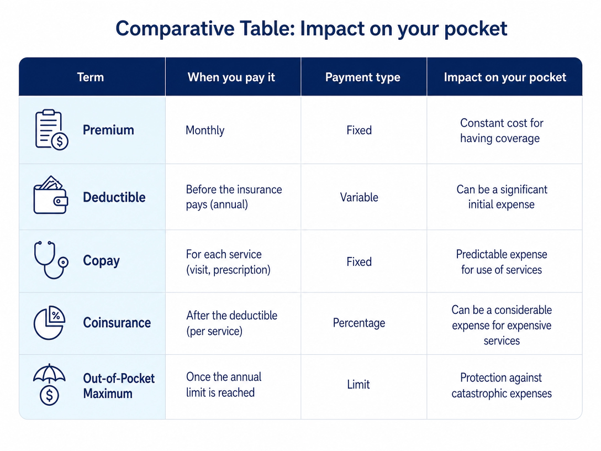
· How does it affect your wallet? It is a fixed expense in your monthly budget. A lower premium can mean immediate savings, but it generally implies you will take on more costs when you need medical care.
·
2. What is the Deductible and When Do You Start Seeing Your Insurance Benefits?
The deductible is the amount of money you must pay out-of-pocket for covered healthcare services before your insurance company begins to pay its share. It acts like an initial barrier that you must clear each plan year.
· How does it affect your wallet? If you have a high deductible, you could pay a considerable amount for treatments or procedures before your insurance steps in. A low deductible means your insurance will start paying sooner, but usually in exchange for a higher monthly premium.
3. What is the Copayment and Why Do You Pay It at Each Visit?
A copayment (or copay) is a fixed amount you pay for specific medical services (such as a doctor's visit, a specialist consultation, or purchasing prescription medications) after you have paid your deductible (though some plans cover certain services with a copay before the deductible is met).
· How does it affect your wallet? It is a predictable and relatively small expense for each service. Copays can vary significantly between plans and types of services, so it is important to know them for each type of care you receive.
4. What is Coinsurance and How Does It Share Costs with Your Insurer?
Coinsurance is the percentage of the costs of a covered medical service that you pay after you have met your deductible. For example, if your coinsurance is 20%, the insurance company will pay 80% of the remaining costs, and you will pay 20%.
· How does it affect your wallet? Unlike a copay (which is a fixed amount), coinsurance is a percentage, meaning your expense can be higher if the total cost of the service is elevated. Understanding this percentage is crucial, especially for expensive treatments or surgeries.
5. What is the Out-of-Pocket Maximum and Why Is It Your Greatest Financial Protection?
The out-of-pocket maximum is the highest amount of money you will have to pay out-of-pocket for covered health services in a plan year. Once you reach this limit, your insurance company pays 100% of the costs for covered services for the rest of the year.
· How does it affect your wallet? It is your financial safety net. Knowing your out-of-pocket maximum gives you peace of mind, as you know that no matter how serious your health issues may be, your annual expenses are capped. It is the most important protection against catastrophic medical bills.
Myth: If I have insurance, I no longer pay anything for my medical services.
Reality: Your insurance covers a portion, but you are responsible for the premium, deductible, copays, and coinsurance until you reach your out-of-pocket maximum. Insurance is a tool to manage and reduce major expenses, not to eliminate them entirely.
Myth: All insurance plans are the same regarding how they apply these terms.
Reality: The way each plan structures its premiums, deductibles, copays, and coinsurance varies enormously. That is why it is crucial to compare and understand the details of each option, subject to an evaluation of your profile.
Frequently Asked Questions
1. Is it better to have a plan with a low premium and a high deductible, or vice versa?
Generally, if you expect to use few medical services, a plan with a low premium and a high deductible might be more economical. If you anticipate frequent doctor visits or have chronic conditions, a plan with a higher premium and a lower deductible could save you money in the long run. The best option depends on your profile and needs.
2. Do copays and coinsurance count toward my deductible?
No, copays and coinsurance generally do not count toward your deductible. However, they do count toward your out-of-pocket maximum, meaning all your out-of-pocket expenses (deductible, copays, coinsurance) add up to reach that annual protection limit.
3. Where can I find these terms in my insurance plan?
All of these terms should be clearly detailed in your insurance plan's Summary of Benefits and Coverage (SBC). If you have questions, your insurance agent or the insurance company can clarify any point for you.
Don't Let Confusion Cost You Money: Get Advice from AV Prada
Understanding your health insurance terms empowers you to make the best decisions for your health and your finances. At AV Prada, we are here to simplify this process, answer all your questions, and help you find the plan that best fits you and your family.
Ready to understand your insurance and protect your wallet? Click here to receive free and personalized advice


