

The Premium Tax Credit (APTC) is a federal subsidy designed to make health coverage affordable for individuals and families with moderate income. This financial assistance directly lowers your monthly premium, allowing more families to access high-quality health plans through the Health Insurance Marketplace (Obamacare). Depending on your income level, this benefit can result in monthly premiums as low as $0.
At AV Prada Insurance & Finance, we know that your family’s health is what matters most, and cost should never be a barrier to protecting it. That is why we specialize in providing guidance rooted in our "Human Touch" philosophy—where we do not just process an insurance policy, but analyze the cost-benefit ratio to find the plan that truly fits your medical and financial needs.
Our commitment is to guide you in using this powerful tool effectively to ensure you receive the maximum possible savings, while maintaining the right balance with your income to protect your annual tax return.
What is the Premium Tax Credit (APTC) and how does it work?
The Premium Tax Credit is a federal subsidy designed to help individuals and families with moderate income afford private health insurance through the Marketplace (Obamacare). It is not a loan; it is money that the government applies directly to your policy to reduce your monthly bill.
How is this credit applied?
There are two ways to use it:
Advance Payments (Monthly): This is the most common option. The credit is applied every month directly to the insurance company, so you only pay a reduced monthly premium—or, in many cases, $0 per month.
When Filing Taxes: You can choose to pay the full monthly premium out-of-pocket during the year and claim the full credit amount as a refund when you file your federal tax return.
Who qualifies for the Premium Tax Credit?
Eligibility is not fixed and depends on a real-time evaluation, but the mandatory criteria include:
Household Income: Your income must generally be above 133% or 135% of the Federal Poverty Level (to avoid being referred to Medicaid). Note: If your income changes during the year, your credit must also be adjusted to prevent debts with the IRS.
Immigration Status: You must have legal status in the U.S. or a valid, documented pending immigration case (Passport, Driver’s License, Work Permit, SSN, etc.).
No Other "Affordable" Coverage: You do not qualify if you are eligible for comprehensive, affordable health insurance through an employer, or if you already qualify for programs like Medicare or Medicaid.
How is the Tax Credit amount calculated?
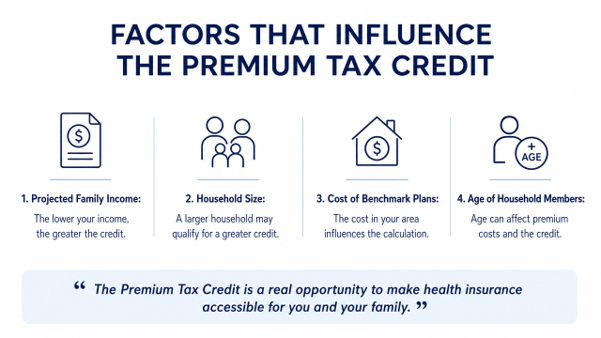
The amount is not the same for everyone. It is calculated based on a combination of these factors:
Estimated household income for the coverage year.
Household size (number of people on your tax return).
Geographic location (your zip code determines local costs).
Age of family members included in the policy.
At the end of the year, the IRS will compare the income you estimated with what you actually earned using Form 1095-A. If you earned more than reported and did not report the change, you might have to owe back a portion of the subsidy (typically between 10% and 15% of the credit received) when filing your taxes.
Myths vs. Realities About the Premium Tax Credit
Myth: The Premium Tax Credit is only for very low-income individuals.
Reality: The program is designed to benefit those who earn too much to qualify for Medicaid (generally above 133% of the Federal Poverty Level) but still need help affording private insurance. The eligibility range is broad, allowing middle-class families to receive significant subsidies that drastically reduce their monthly payments.
Myth: If I receive the credit, I will have to pay it all back at the end of the year.
Reality: You only owe money back if there is an unreported discrepancy between your estimated and actual income. Thanks to the IRS matching process, if your estimate is accurate and you report changes promptly, you minimize any risk. Even in cases of an error, you typically only repay a percentage (between 10% and 15%) of the total credit received—not the full amount.
Myth: Applying for it is very complicated.
Reality: While the system allows for self-application, working with a certified AV Prada agent turns a technical process into a simple experience. We handle Marketplace navigation to prevent errors that could lead to IRS audits or financial headaches.
Frequently Asked Questions
1. Do I need to file taxes to receive the Premium Tax Credit?
Yes. Filing a federal tax return for the year you receive the benefit is mandatory. This is required to complete the reconciliation process using Form 1095-A, where the IRS verifies that the subsidy received aligns with your actual income.
2. What happens if my income changes during the year?
It is vital to report any changes in income or household size to your agent immediately. At AV Prada, we follow the golden rule: "If your income changes, your application changes." Reporting these updates ensures your subsidy adjusts in real time, protecting your tax refund at the end of the year.
3. Does the Premium Tax Credit cover the entire cost of my insurance?
In many cases, yes, it can cover 100%. Depending on your income and selected plan (especially within Bronze or Silver tiers), it is possible to get a $0 monthly premium. The ultimate goal is to make coverage affordable without creating a financial burden on your household.
Secure Your Peace of Mind with AV Prada
Understanding the Premium Tax Credit is the first step toward accessing quality health coverage without straining your finances. At AV Prada Insurance & Finance, we are defined by our "Human Touch"—we do not just sell insurance; we offer ongoing, personalized guidance. We are committed to leading you step-by-step to ensure you maximize all the benefits you are entitled to.
Ready to find out how much you can save on your health insurance? Click here to get a free, personalized consultation or contact us at our official numbers. Your well-being and your wallet

